
As of March 2026, quantum computing is no longer just a futuristic promise—it’s edging into practical territory. While the hype that peaked in 2025 has tempered somewhat, with some experts predicting a potential cool-off if tangible applications don’t accelerate, the field is witnessing a surge in engineering breakthroughs focused on reliability and scalability.
This year marks a pivotal “transistor moment” for quantum tech, akin to the early days of classical computing, where foundational hardware advancements are paving the way for widespread adoption. From error-corrected systems to hybrid architectures, here’s an in-depth look at the latest developments, key players, and what lies ahead.
The Shift to Fault-Tolerant Quantum Systems
One of the biggest hurdles in quantum computing has been error rates—qubits are notoriously fragile, prone to decoherence from environmental noise. But 2026 is the year error correction is hitting its stride. In February, Quantinuum demonstrated a groundbreaking use of high-rate quantum low-density parity-check (QLDPC) codes, creating 48 to 94 logical qubits from just 98 physical ones. This achieved a logical two-qubit gate fidelity of 99.99%—an 8x improvement over raw physical errors—and reduced simulation errors by about 30%. This “beyond break-even” milestone challenges traditional surface code approaches, favoring platforms like trapped ions and neutral atoms for fault tolerance.
Similarly, a new study on IBM’s 127-qubit processor introduced a method to suppress errors at the logical level, achieving record reductions in entangled logical qubits. And in January, Google Research unveiled dynamic surface codes for quantum error correction, using fewer couplers and novel gates to eliminate correlated errors. These advances signal a move from noisy intermediate-scale quantum (NISQ) devices to more stable, fault-tolerant machines.
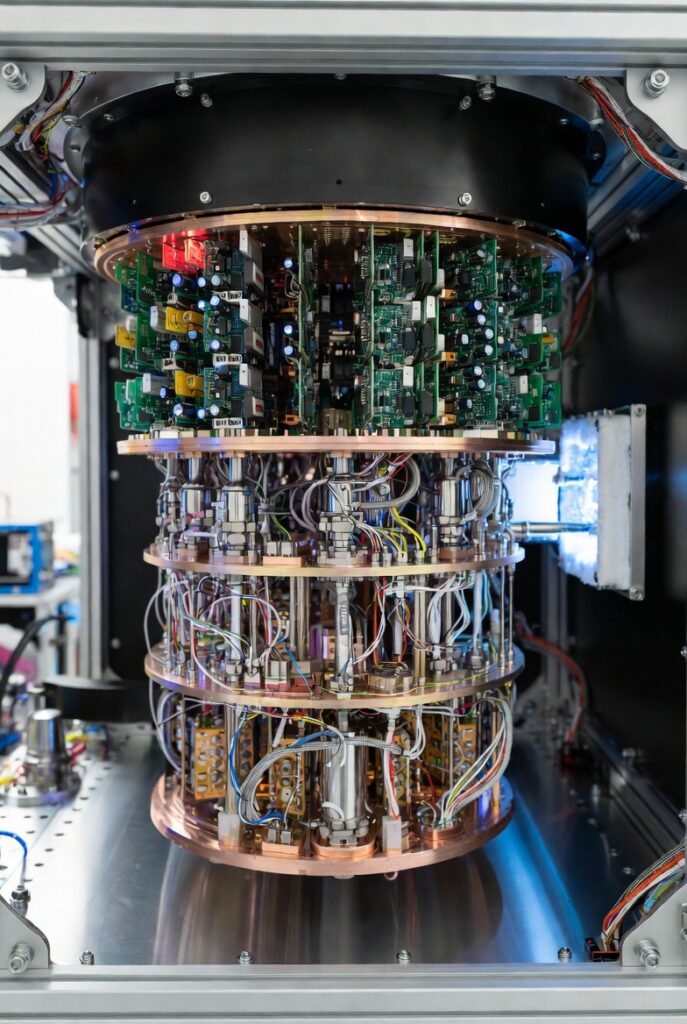
Princeton researchers also made waves in late 2025 (with implications carrying into 2026) by developing a superconducting qubit that boosts coherence time by 15 times industry standards, accelerating the path to practical systems.To visualize the intricate hardware behind these feats, here’s a glimpse into typical quantum setups:
Are You Ready To Get Started?
Learn Technology for free starting today! williambenz.com offers a sea of free information and courses! Start Today!
From Linux, Cybersecurity to even Development! Williambenz.com offers it all!
Key Trends Shaping Quantum in 2026
Industry insiders like those at Quandela predict four major trends dominating this year: hybrid quantum-classical computing, early industrial implementations, advances in error correction, and heightened cybersecurity focus. Hybrid systems, where quantum processors handle complex optimizations while classical computers manage routine tasks, are gaining traction for their efficiency.
Neutral atom quantum computing is another “big leap,” with companies like Microsoft, Atom Computing, and QuEra planning to deliver small error-corrected machines by year-end. For instance, Microsoft’s Magne system will feature 50 logical qubits from 1,200 physical ones, operational by early 2027. QuEra has already shipped a similar machine to Japan’s AIST for global access in 2026.
Quantum-as-a-Service (QaaS) is democratizing access, allowing businesses to tap into quantum power without building their own hardware. On the AI front, quantum is supercharging machine learning, with photonic AI systems emerging as low-energy alternatives.
Major Players and Commercial Momentum
The race is heating up, with acquisitions and expansions fueling growth. Quantum Computing Inc. (QUBT) acquired Luminar Semiconductor in February, adding fabrication capabilities and eyeing revenues from its Fab 1 facility. Google’s Willow chip, announced in late 2024, continues to influence 2026 with real-world speedups.
Toshiba and Quantum Corridor are pushing for primetime deployment, emphasizing migration from labs to users. Bloomberg highlights the high-stakes competition, noting quantum’s potential to supercharge AI but warning of delays in applications.On social platforms, excitement is palpable: Discussions range from quantum’s role in reshaping tech futures to specific breakthroughs like “phantom codes” for stability.
Challenges and the Road Ahead
Despite progress, quantum remains years from ubiquity. High costs, energy demands, and the need for ultra-cold environments persist. Geopolitical tensions in the AI-quantum race add complexity. If 2026 doesn’t deliver more “useful” quantum—beyond benchmarks—the hype could wane further.
Yet, optimism abounds. As one expert notes, we’re in a “fault-tolerant foundation era,” where adding qubits actually improves performance. By year’s end, expect more industrial pilots in fields like materials science and optimization, potentially transforming industries from finance to pharmaceuticals. Quantum computing isn’t quiet—it’s just getting serious.